Websites which feel alive
Not a theme with your logo dropped into it. Every page is built ahead of time and served as a file, so it opens instantly on a phone; the motion exists to show what the product does rather than to decorate it; and the custom tools - a configurator, a calculator, a live customizer - do the selling before anyone speaks to you. The structured data, the canonicals and the readability work are part of the build, not a second project you buy later.
A site that looks fine and does nothing is a quietly embarrassing thing to own. Owners are usually anxious about saying so out loud.
Some of that work is shown below.
 GMI Custom Grinders
B2B custom grinder store. Scroll-scrubbed 3D product video, a canvas customizer that renders your logo onto a grinder live, and a quote flow that carries the artwork. Built in Next.js.
Measured in Google Search Console, September 2026: ranked #1 on Google for six of its commercial searches, including custom grinder manufacturer and wholesale custom grinders.
 YourCite
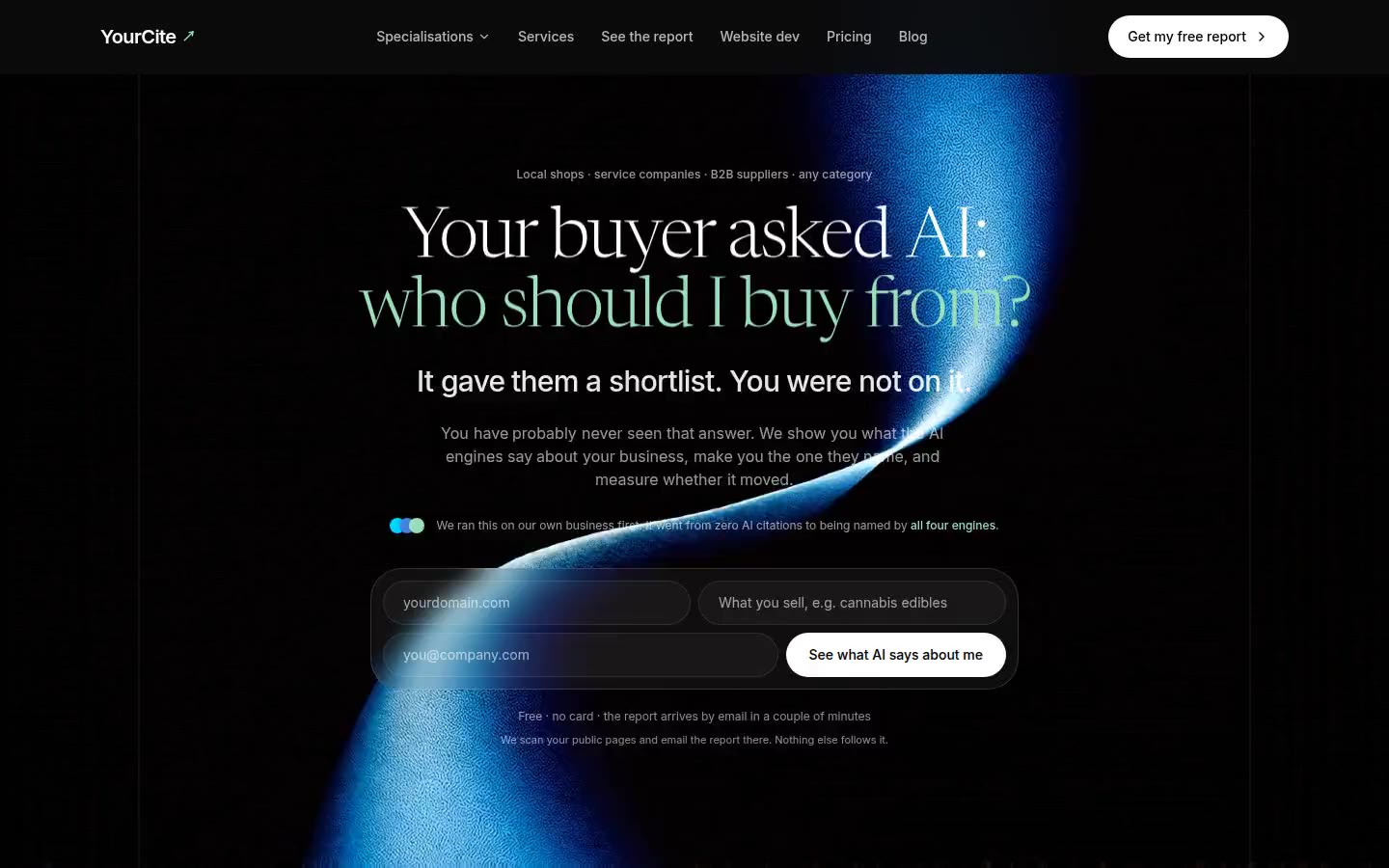
This site. A single-page app with scroll-driven motion, a neon-tube background, and an FAQ that answers live as you type from a bank of real buyer questions.
Measured 4 October 2026: this domain ranked #2 on Google US for "why is my dispensary not showing up on google" within five weeks of registration.
How these were captured: full-page scrolling screen recordings of the live sites, taken on 5 October 2026 with a headless Chromium browser at 1440x900, and converted to looping GIFs. Nothing is mocked. You can open each site yourself and compare.
What does every site we build come with?
- Static generation. Pages are built ahead of time and served as files, so they load fast on phones and every page is fully readable to search engines and AI engines, no rendering required.
- 3D and motion where it earns its place. Scroll-scrubbed video, canvas work and interactive product views. Motion that explains the product, not motion for its own sake, and it all falls back gracefully when a phone says no.
- Custom tools, not just pages. Configurators, calculators, live customizers. The GMI customizer renders a customer's own logo onto a grinder in the browser before they ever talk to anyone.
- The visibility work is included. Titles, structured data, canonicals, sitemaps, and pages written to answer the questions buyers actually search. The site ships ready to be found, not as a brochure that needs a second project to become visible.
How does a project run?
One site, ten days from frozen scope and content. We build in Next.js or plain static pages depending on what the project needs. If you already have a site, we can scope the rebuild or bolt the visibility work onto what exists.
A site starts at $500. The figure moves with the number of pages, whether the product needs a custom tool, and how much of the copy we write from your material. You get the scope and the price in writing before anything is built.
Who this suits and who it does not
It's for a business that sells something specific and whose buyers search for it: a manufacturer, a distillery, a clinic, a studio with a service list. The site exists to be found and to convert, and the visibility work is part of the build rather than a phase two you buy later.
It's not for a site nobody searches for, or for a team that wants a theme installed this afternoon. We build one way: static, fast, structured and measured. If that is the wrong fit, we would rather say so before you pay for it.
What buyers ask before they hire us
How long does a website take?
Ten days from the point the scope and the content are frozen. The clock starts when we have the page list agreed and your material in hand, not at the first conversation, because a build that waits on copy is the only thing that makes it slower.
What does a website cost?
It starts at $500. The figure moves with the number of pages, whether the product needs a custom tool such as a configurator or a calculator, and how much of the copy we write from your material. You get the scope and the price in writing before anything is built.
Do you only build custom sites, or can you work on Wix or Shopify?
All three. We work on Wix and Shopify where the client is already there and the platform suits the business, and we build custom static sites when the site is being made from scratch. The visibility work - titles, structured data, canonicals, sitemaps, pages written around the questions buyers type - is the same in every case.
Will the site rank on Google?
Nobody can promise a position, and you should be wary of anyone who does. What we can promise is that the site ships in a state search engines and AI engines can read: static HTML instead of an empty div, a canonical on every page, a sitemap that lists the URLs that answer, structured data for the product and the business, and pages built around real buyer questions. Then we measure it in Search Console and show you what moved.
Who writes the content?
We do, from your own material: your product, your process, your proof. Nothing on the site is invented, which is why every page passes a fact check against your own sources before it goes live.
Can I see the work before I commit?
Yes. The GMI Custom Grinders case study shows the 3D scroll, the live customizer and what the site did in Search Console, and how we compare sets out what is different from a template build.
Honestly, none of this is worth doing if the offer is unclear. A fast site that says nothing still sells nothing. We will say so before we quote.